
Feeding for butterfat that supports profitability
Butterfat is an important component of milk, as it forms part of the milk payment system. It is also commonly used as an indicator of cow health. Stable, healthy butterfat levels generally indicate that cows are performing well. In markets where butterfat plays a key role in milk valuation, maintaining consistent butterfat levels is essential for optimal returns.

Influencing butterfat production through nutrition
Around 60% of the variation in milk fat content depends on factors like management, climate and breeding. The effect of nutritional factors on milk fat content is around 40%. Therefore, there is an opportunity to steer butterfat through nutrition. To support farmers, who want to increase their milk fat levels, De Heus has developed a new nutrient we call ketogenic potential – in short KEP. Through using KEP in our ration calculations, we are able to predict and target the factors that deliver high milk yields and high milk fat in our rations.
KEP helps to predict changes in milk fat on farm
KEP was developed after extensive research. By combining our knowledge of the cows’ digestive system with our advanced feed calculation system. The results are not only theoretical, however, and were based on several practical trials and scientific research conducted over the years.
One of the main drivers of butterfat production is the result of long chain fatty acid metabolism (LCFA) and volatile fatty acids (VFA) production in the rumen plus VFA production in the large intestine. Both contribute significantly to fat synthesis in the udder as shown in the picture below.
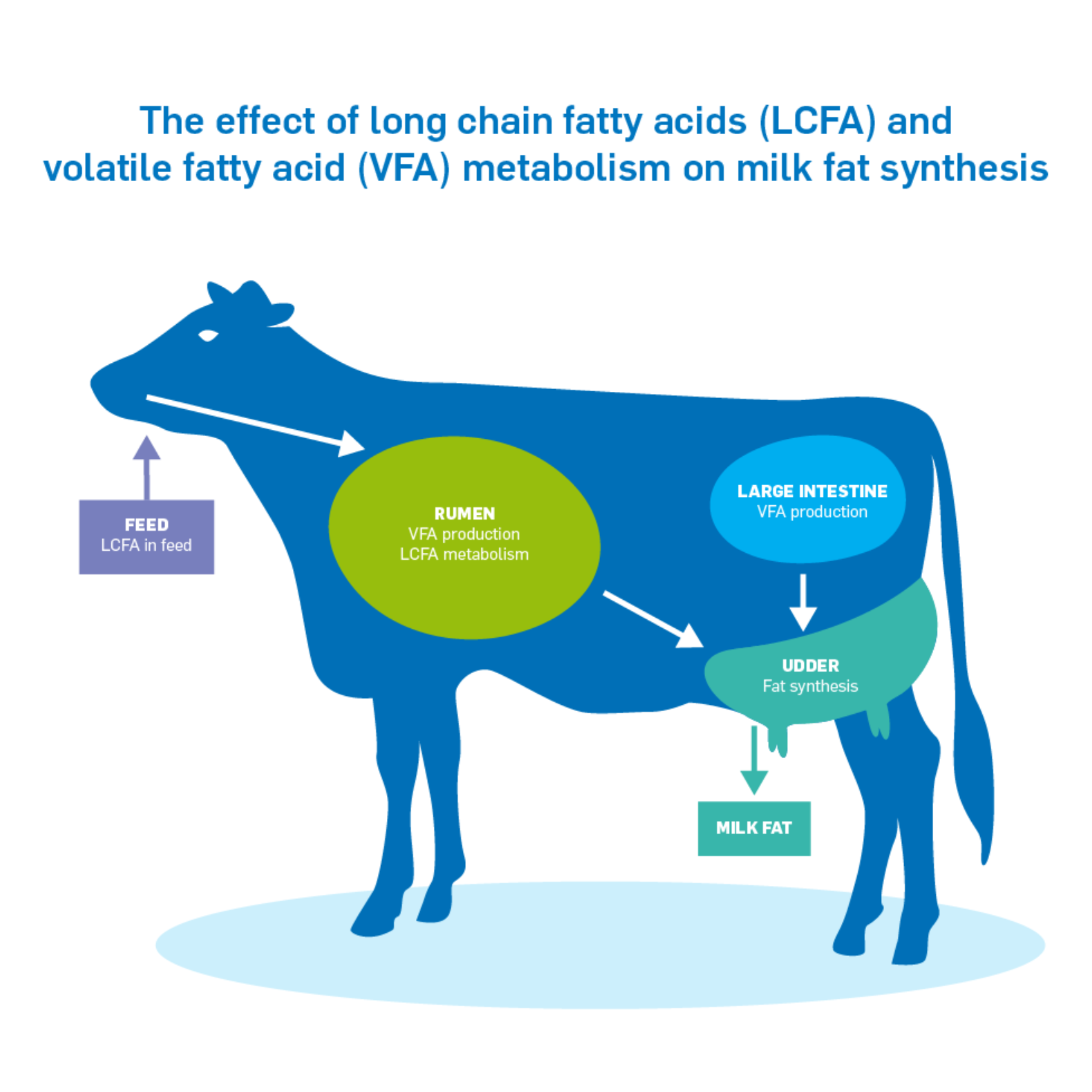
Optimizing your dairy cow ration for high milk fat production
It is important that the fatty acid composition of roughages, feeds and concentrate ingredients are considered. The LCFA palmitic acid (C16:0) from feed can be incorporated directly into milk fat, giving a positive contribution to higher milk fat production (figure 2). Unsaturated fatty acids (UFA) decrease milk fat synthesis. However, the extent of milk fat depression depends on the specific UFA. Through closer studies on UFAs the nutritional parameter we call weighted unsaturated fatty acids -(w)UFA was developed. This (w)UFA is used alongside other nutrients, in our calculation of KEP. When (w)UFA increases, we see milk fat production decrease. Figure 2 illustrates these trends.
Figure 2. The effect of palmitic acid (C16:0) level or unsaturated fatty acid ((w)UFA) level in the total ration on milk fat content change. Blue line depicts the typical range in the diet, whereas the green line represents more extreme levels.
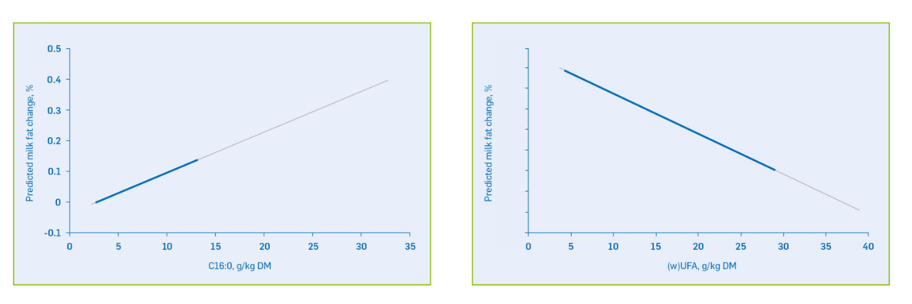
For all forages, ingredients and compound feeds LCFA levels, including C16:0 and wUFA, are now calculated and converted into the KEP nutrient. wUFA alongside other nutrients known to affect milk fat are all built into the nutrient KEP.
With KEP we predict how rations may affect butterfat levels;
- When using different feedstuffs
- When changing maize, small grain or grass silages
- When using feed additives (e.g.: bypass fats and sodium bicarbonate).
By optimizing rations based on KEP, dairy farmers can achieve the highest levels of butterfat, realising significant financial benefits for their farm.


Want to know more?
Find out how we support our farmers in many places to manage their milk fat.


