Breed choice:
Firstly, when starting a free-range pig farm, you will have to choose from a variety of breeds. Breed choice should be led by characteristics such as disease tolerance, heat resistance, and good mothering abilities. Free-range pigs must be able to walk and forage, tolerate exposure to the elements, maintain body condition on variable diets, and reach market weight in a reasonable time. These traits are seen in indigenous and free-range adapted breeds. While these breeds tend to be slow growing, with lower carcass yields, they are hardy and well-suited for a free-range operation. Crosses between commercial and indigenous breeds can strike a balance between hardy genetics and improved growth rates. On the commercial side, the Landrace has been noted to have excellent mothering abilities, large litter sizes, high lean meat yield, and good feed efficiencies. PIC genetics are focused on high performance, uniformity and good feed conversion ratios and are popular in commercial systems.
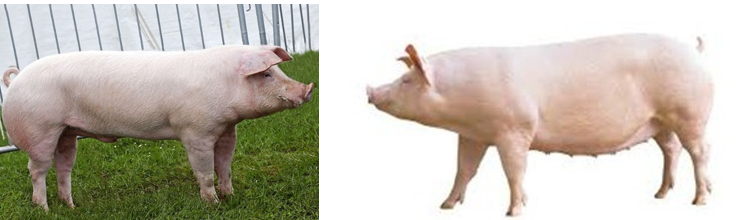
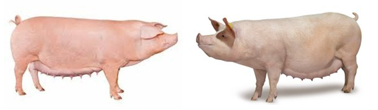
Figure 1: Example of the Landrace (left) and PIC (right)
TOPIGS genetics have good growth rates and carcass quality, while also focusing on lean meat production. DanBred genetics have focused on feed efficiency, reproductive output and lean carcasses. The Landrace and the PIC could be suitable for semi-intensive or semi-free-range systems, but tend not to fare well in harsh extensive systems. Crossing these breeds with indigenous genetics could improve their performance in free-range systems. Both the TOPIG and the DanBred have been used successfully in free-range systems, but require good nutrition and management to flourish.
Figure 2: TOPIG (left) and DanBred (right)
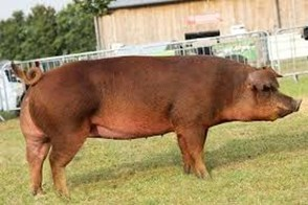
The Duroc has often been used in free-range systems. This brown coated breed is less affected by sun exposure, has strong legs and better adaptability, compared to the Landrace. The Duroc also has high intramuscular fat content that increases flavour in the meat and a faster growth rate, compared to indigenous breeds. All the commercial breeds require supplementary feeding to perform well in free-range systems.
Figure 3: Duroc breed
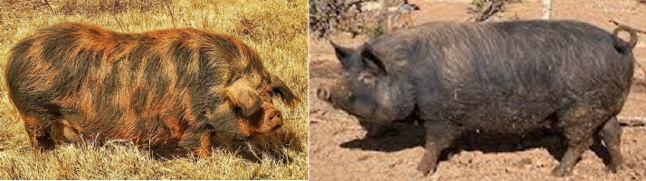
Popular indigenous breeds include the Kolbroek, which is adapted to low-input and extensive systems, and has good fat deposition that increases flavour in the meat. The Windsnyer, a crossbred veld pig, is known for its heat tolerance, disease resilience and efficiency in utilising low-quality feeds.
Figure 4: Kolbroek (left) and Windsnyer (right)
Climate and housing:
The South African climate varies across the country, making some areas more viable for free-range farming than others. Pigs are sensitive to heat stress and sunburn – especially the white breeds. Pigmented breeds like indigenous breeds or the Duroc fare better in these systems. Free-range pigs also require good forage and water availability, faring better in moderate climates. KwaZulu-Natal, the Eastern Cape and Mpumalanga have moderate rainfall and milder temperatures, which are conducive to good pasture growth. These areas would be well-suited to free-ranging. The Western Cape and Gauteng climates vary between winter and summer, and a free-range system here would require adequate shade and irrigation to thrive.
The Northern Cape and Limpopo would be better suited for robust breeds with more indigenous genetics due to the extreme heat and water scarcity. When the climate does not naturally support the needs of the pig, more supplementary feeding and infrastructure are needed, which leads to higher input costs.
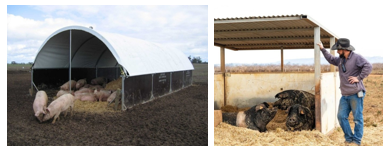
Figure 5: Examples of permanent housing
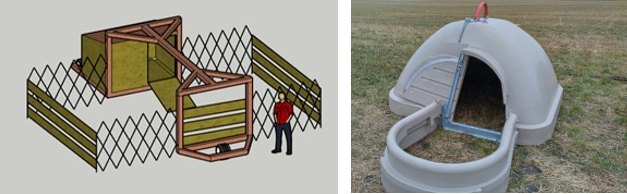
Housing should be available to free-range pigs, especially in less extensive systems where natural shelter cannot be utilised. Housing should provide shade and a dry sleeping area for the pigs. Simple open-sided wooden or steel frames with roofs will be efficient. Semi-enclosed hut structures with bedding, such as straw, offer the best protection for farrowing and piglet rearing. Designs for mobile housing include simple moveable steel pens and a “pig-tractor”. This is where a pen is mounted on wheels and can be hitched up to a tractor. Movable units are good for supporting rotational grazing. By government regulation, a free-range system must have 5m² of floor space per pig.
Figure 6: Schematic of a pig tractor (left) and farrowing hut (right)
Camp fences should be high enough that pigs cannot jump over them. Electric fencing is one of the best ways to keep free-range pigs in and other threats out of your camps. Rotational grazing is one of the more sustainable methods of free-ranging, allowing pastures to recover before being grazed or foraged on again. Wallows should be available in the camps to aid pigs in cooling down in hot weather, as pigs do not have the ability to sweat.
Herd nutrition, management and breeding:
Foraging alone does not provide adequate nutrition for efficient growth. Foraging should be supplemented by grain-based feed when pasture quality and availability are good. However, supplying a high-quality complete feed and allowing supplementary foraging results in the best growth rates, slaughter weights and health of the pigs. Feed can be provided in troughs at the same time each day – minimising stress. Then the pigs may forage to supplement their intake. This allows pigs to express their natural behaviour, while still benefiting from a high-quality diet. Alternative systems include purely pasture-based systems, ideally with rotation grazing and high-quality pastures. These may include a mixture of legumes and natural grasses. Other pasture-based systems may include byproducts such as brewers’ grain and vegetable wastes. Pasture-based systems must be managed better to limit protein deficiencies. Where it is easier to ensure optimal growth and performance with good quality complete feeds. Access to clean water is critical for free-ranging animals, as water is one of the most important nutrients. All water sources, including boreholes, dams, rivers and canals, should be routinely tested to ensure high-quality water availability to the pigs. Water troughs, as well as water nipple systems, can be used in free-range farming.
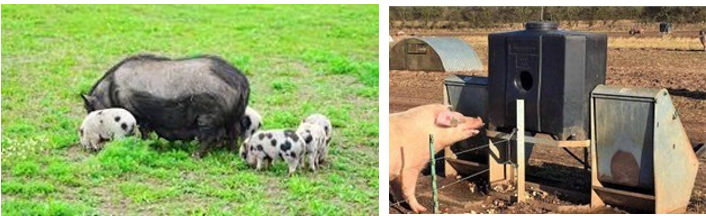
Figure 7: Piglets foraging with a sow (left) and an example of a water nipple system (right)
The feed conversion ratio (FCR) of free-range pigs is always higher (worse) than that of commercial pigs. This is due to the lack of climate control and higher energy expenditure on other activities. Due to these factors, piglets in free-range systems are often lighter when compared to their commercial counterparts at the same age. In a free-range system, piglets are weaned between 4 and 8 weeks of age, compared to a commercial setting where weaning takes place at 3 to 4 weeks of age. It is required to extend the weaning age of free-range piglets to ensure heavier, more robust piglets. One of the key elements in producing good-quality piglets with high weaning weights is nutrition. Creep feed should be offered three days after birth; this will supplement the sow’s milk and result in better intakes. High-quality lactation feed will support optimal milk production.
In an ideal free range system, the sows, boars and growers would be housed separately. Housing the sows separately allows for better control of the nutrition pre- and post-farrowing. In free-range systems, it is feasible to produce two litters per sow per year and, in exceptional cases, up to 2.5 litters/sow/year. Providing separate housing to the boars prevents uncontrolled breeding, allows them to maintain body condition and avoid overheating in the warmer months. Natural mating is the most common and viable option in free-range systems. The breeding ratio ranges from 1 boar per 10 sows to 1 boar per 20 sows.
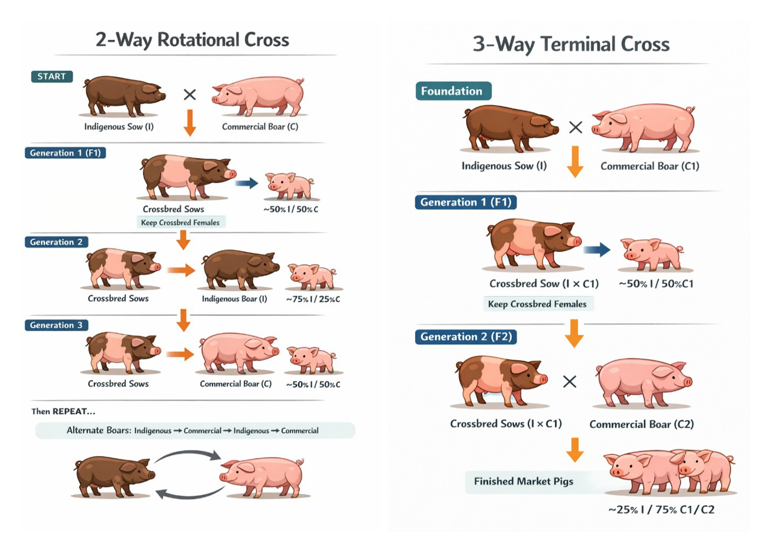
In cross-breeding systems, it is advisable to use the sow as the indigenous breed and the boar as the commercial breed. One of the most common crosses in South Africa is the Kolbroek cross with Landrace. This maximises hybrid Vigor, ensuring a sow with good mothering abilities that produces hardy piglets with improved growth potential. The best approach to cross-breeding is the 2-way rotational or 3-way terminal cross. In the 2-way cross, you would use an indigenous breed as the sow and cross her with a commercial boar. You would then keep the crossbred females as the sows and breed them to the indigenous breed in the second generation. In the third generation, you would mate that crossbred sow back to the commercial breed. In the 3-way cross, you create a maternal line by crossing an indigenous sow with a commercial boar. You keep the first generation as your sow base and mate them to a third terminal boar.
Figure 8: Illustration of a 2-way rotational and 3-way terminal cross
The 2-way cross is self-replacing and focuses on resilience over output, but requires intensive management. The 3-way cross requires more space to manage breeding groups and access to good boar genetics.
Health management and biosecurity:
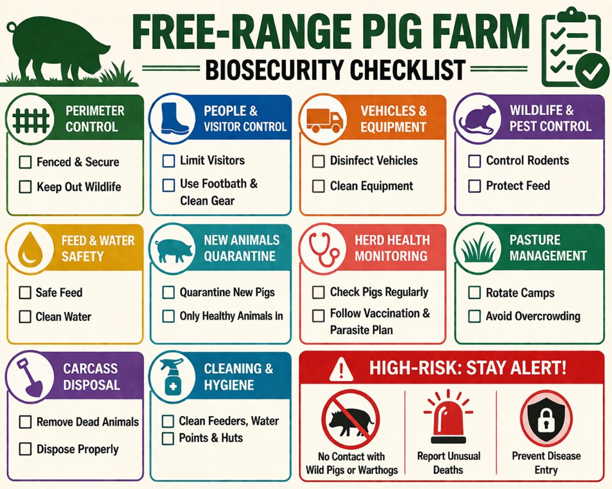
In free-ranging, the key to healthy animals lies in preventative health management as well as a quick response time. Biosecurity plays a key role in protecting the herd from potential disease threats, as free-range systems face greater exposure to diseases and wildlife contact. Perimeter fences can be a great method of deterring wildlife before they come into contact with your herd – providing one extra barrier of protection. Having only one entry point on the farm provides more control over your access point. One controlled access point for disinfecting vehicles and people is easier to manage than multiple entry sites. Biosecurity measures such as footbaths and sanitisers can still be used upon entry to the farm and between different camps – although these may not be effective in rotational grazing systems.
A good vaccination schedule should be in place to prevent outbreaks of major diseases. Although more tedious in free-range systems, vaccinations are worth the effort for the reward of a disease-free herd. Common vaccinations include those against African Swine Fever, Erysipelas and Parvovirus. Deworming should also be done regularly to control internal parasites. Due to environmental exposure, free-range herds can have increased parasite loads compared to commercial herds. Rotational grazing can help to reduce the parasite load because pastures are given a rest period where the host (pigs) is absent. Continued monitoring of the quality of the water supply can help to identify bacterial contamination early on, before the effects become severe.
Figure 9: Example of a biosecurity checklist
In a free-range system, close herd monitoring and regular observation are two of the most effective ways to prevent health problems. Farmers should focus on any changes in appetite, behavioural changes, performance declines and visible signs of diseases. New pigs should be quarantined and monitored for signs of infection for at least 2 weeks before introducing them into the herd. Always ensure you buy your animals from reputable suppliers. Pest control in free-range farming can be a challenge, but storing feed securely can prevent additional pest attractions. Mortalities should be removed from the system immediately and properly disposed of to prevent potential contamination of the herd. Existing structures such as the farrowing huts, feeders and water points should be regularly cleaned and properly disinfected. A biosecurity checklist is a useful tool in ensuring biosecurity measures are followed.
Conclusion:
Free-range pig farming in South Africa is viable when managed correctly. Free-range pig farming is unlikely to replace commercial pig farming in South Africa, but it does offer a way into a niche market of welfare-conscious consumers at premium prices. There are many aspects to be taken into consideration when starting up a free-range system, such as breed choice, climate and housing, herd management and breeding practices. Other factors to focus on are overall herd health and biosecurity management. There is no singular blueprint for free-range pig farming, but choosing an adaptable breed, or breeds, suited to the local climate and providing adequate quality nutrition can maximise production efficiency. While free-range growth rates may never rival commercial growth rates, good management practices and biosecurity will optimise free-range growth. When managed and executed properly, free-range farming can deliver high-quality pork with improved animal welfare, fetching a premium in the market. Free-range pig farming is a promising and growing area in South African agriculture.