In this article, we shift our focus to the practical management of water on the farm. We will explore how water availability, trough size, trough placement, and cow behaviour influence drinking patterns, and discuss practical considerations that can help ensure cows have unrestricted access to water throughout the day.
Major Factors Influencing Water Intake in Dairy Cattle:
Free water intake (the consumption of water that is not bound to food or other substances) by dairy cows makes up 80-90% of their total water need. Cow size, milk yield, dry matter intake, relative humidity, temperature, and water temperature determine the amount of water consumed by a cow. During periods of heat stress, water is a crucial nutrient, as the physical properties of water allow heat to be transferred from the body to the environment. On the contrary, during cold stress, body heat is conserved through the heat capacity of body water, which acts as insulation.
Eating patterns and drinking behaviour
Water intake is closely linked to feeding behaviour. Periods of peak feed intake are usually followed by increased water consumption, and cows naturally alternate between eating and drinking when given the opportunity. This relationship highlights the importance of locating water troughs close to feeding areas, allowing cows easy access to water after consuming feed.
One of the most important drinking periods occurs immediately after milking. Cows often seek water after milking, before returning to feed or resting areas. For this reason, providing easily accessible water points along exit routes from the milking parlour can significantly improve water intake. When water is not readily available during these peak drinking periods, cows may reduce both water and feed intake. Over time, this can negatively affect milk production, animal performance, and overall herd efficiency.
Cow dominance and social behaviour
Social hierarchy plays a major role in determining water access within a herd. Dominant cows frequently control access to resources such as feed bunks, resting areas, and water troughs. Subordinate cows may therefore spend less time at watering points, particularly when trough space is limited or when only a single watering point is available. These cows often consume less water and subsequently less feed, which can negatively affect production.
The impact of dominance becomes more pronounced when troughs are small, poorly positioned, or unable to accommodate multiple animals simultaneously. Providing large troughs and multiple access points allows more cows to drink at the same time and reduces competition (see case study below). This is particularly important in larger herds where social pressure can significantly influence drinking behaviour.
Water temperature
Water temperature can significantly influence water intake. Research has shown that cattle generally prefer water temperatures of between 10 and 20°C. During periods of hot weather, cows often increase their water consumption, and cool drinking water can provide temporary relief from heat stress as it absorbs body heat. As environmental temperatures rise above 27°C, water requirements may increase substantially due to increased sweating and respiration rates.
Conversely, when temperatures fall below 10°C, water intake may decrease. Reduced water intake during cold weather often occurs because cows are less inclined to consume large quantities of cold water. This can indirectly reduce feed intake and milk production. For this reason, maintaining easy access to fresh water throughout the year remains important, regardless of the season.
|
Body Weight (kg)
|
Milk Produced (L)
|
Ambient Temperature
|
|
Water intake (L) at
4ºC
|
Water intake (L) at
16ºC
|
Water intake (L) at
27ºC
|
|
Heifer/Calf
|
|
|
|
|
|
90
|
-
|
9.0
|
11.3
|
14.9
|
|
180
|
-
|
16.7
|
20.1
|
27.5
|
|
360
|
-
|
28.4
|
35.6
|
47.7
|
|
540
|
-
|
39.1
|
48.6
|
65.3
|
|
Dry Cow a
|
|
|
|
|
|
630
|
-
|
43.1
|
54.0
|
72.9
|
|
720
|
-
|
46.8
|
57.6
|
77.9
|
|
Lactating Cow b
|
|
|
|
|
|
630
|
9.0
27.0
36.0
45.0
|
54.0
99.0
121.5
140.0
|
55.3
117.5
143.6
169.0
|
80.6
138.2
174.2
205.7
|
Table 1: Water intake of dairy cattle according to SANS 1694:2018
a Support and upkeep pregnancy
b Support and upkeep milk production
Water Trough Space
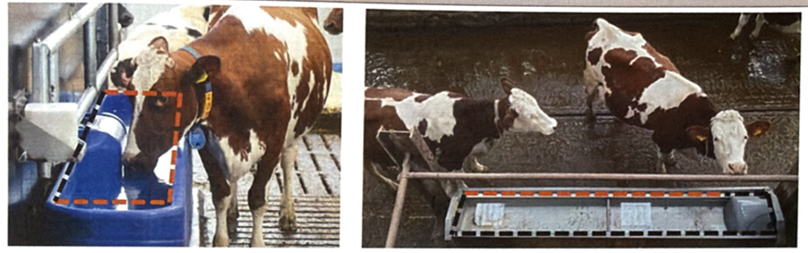
Adequate access to drinking water is crucial. As a minimum standard, dairy cows should be provided with approximately 6 cm of trough space per cow, although 8–10 cm per cow is recommended in high-producing herds or during periods of heat stress.
Because cows tend to drink simultaneously, particularly after milking, the trough design should allow approximately 10% of the herd to drink at the same time. As a practical guideline, provide around 70 cm of drinking space per cow drinking simultaneously. For example, a 100-cow herd should have enough trough space for 10 cows (approximately 7 m of total accessible trough perimeter).
At least two water troughs or watering locations should be provided per group. Providing multiple, well-positioned water points is particularly important in larger herds and during periods of heat stress demand.
Illustration 1: Orange lines and dashes are what need to be measured, and black lines must be excluded.
Access to water troughs
Even when sufficient water is available on the farm, poor trough placement can limit intake. Water points that are located far from feeding areas, resting areas, or cow traffic routes may discourage cows from drinking frequently enough. Cows typically spend only around 10 minutes per day actively drinking, but approximately 30 minutes per day around water points, making these areas prone to congestion. Water should therefore be easily accessible, particularly immediately after milking and during peak feeding periods.
At pasture, cows should ideally not walk more than 250 metres to a water trough. Additional water points in collecting yards and along routes to grazing areas can further encourage intake. Troughs should also be located on dry, well-drained surfaces to maintain unrestricted access.
Water Supply and Flow Rate to Drinking Devices
A common cause of reduced water intake is an interruption in water supply to troughs or drinking devices. Corroded valves, blocked pipes, faulty float mechanisms, inadequate pipe sizing, or poor maintenance can prevent troughs from filling properly.
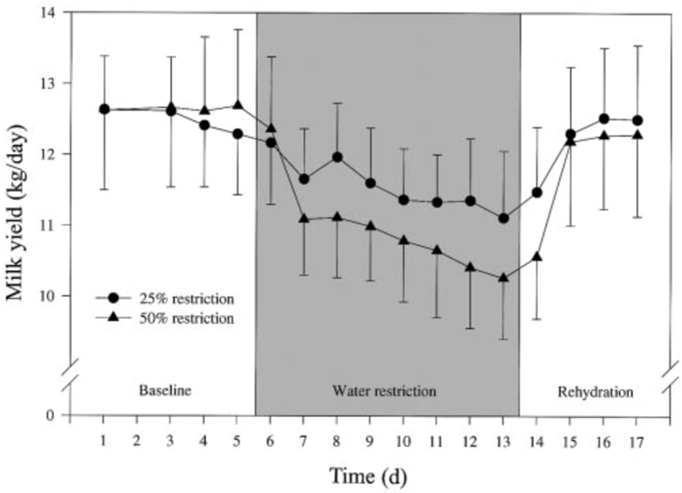
A minimum flow rate of approximately 0.15 L/min per cow in the herd is recommended (e.g. 15 L/min for a 100-cow herd). However, because cows can drink up to 14 L/min per cow, watering systems should be designed to accommodate peak demand, as ten cows drinking simultaneously may consume up to 140 L/min.
Figure 1: The effect of water restriction on milk yield.
Chemical water quality
High concentrations of dissolved salts, minerals, or other chemical constituents may reduce water palatability and discourage voluntary intake. In some cases, animals may tolerate poor-quality water for a period, but production losses can still occur due to reduced consumption and altered mineral balance.
Contamination from manure, algae, fertilisers, agricultural runoff, or microbial organisms can negatively affect both water quality and palatability. Dirty troughs may develop unpleasant tastes or odours that reduce water intake, while bacterial contamination may pose health risks. Regular cleaning of troughs and routine water testing form an essential part of good water management.
Case Study:
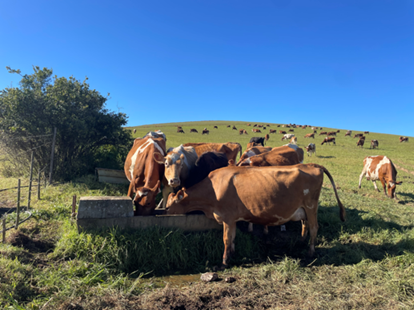
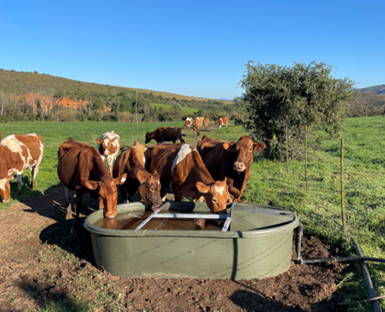
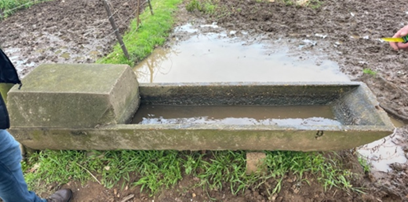
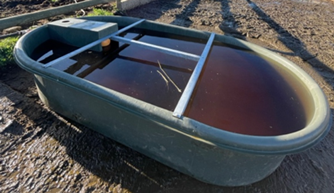
The farm originally had small sheep water troughs (illustration 1). It was replaced with larger troughs (illustration 2). At a smaller trough, cow dominance plays a bigger role, as the dominant cows will occupy drinking spaces, preventing others from drinking. The bigger trough immediately allows more cows to drink at once, decreasing the cow dominance factor.
Illustration 2: Cows drinking water at a trough with insufficient space.
Illustration 3: Cows drinking water at a trough with sufficient space.
Illustration 3, the water looks “dirty”, and illustration 4, the water looks a lot clearer and “cleaner”. However, when the water was analysed, the pH of these two water sources (illustration 3; illustration 4) was significantly different. The “clear” water had a pH of 4.7, and the “muddy” water had a pH of 6.1, indicating that the water that appeared to be dirty was much better quality.
“The way water looks is not the only determining factor in water quality. Neither is pH.”
Illustration 4: Water trough containing dam water.
Illustration 5: Water trough containing borehole water.
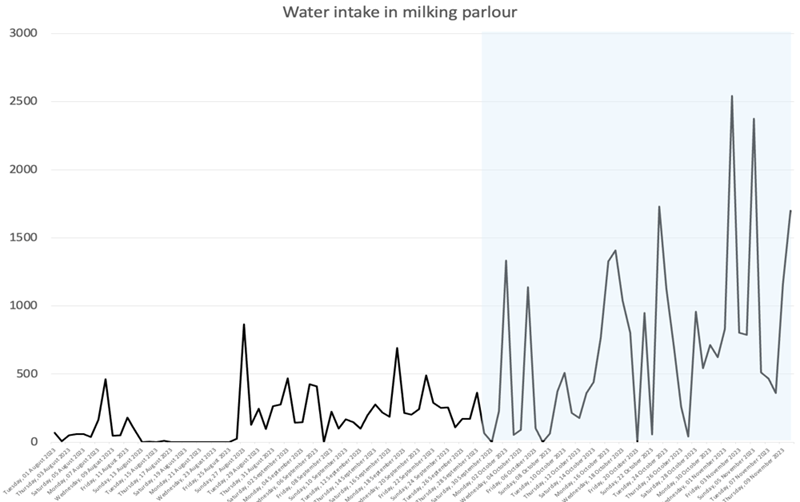
Water intake within the milking parlour was measured. The water originally used was borehole water. The water source was changed to the dam water. Water intake was measured with flow meters. In the figure below, the blue illustrates the change to the more neutral dam water. It is clear that water intakes increased drastically with improved water quality:
Figure 2: Water intake in milking parlour with borehole water (before) and dam water (after).
The “highs and lows” in the graph can be due to many factors. For example, warmer days cause higher intakes and colder days lower intakes.
Conclusion:
Water management on dairy farms extends far beyond simply ensuring that water is available. Even when water quality is acceptable, factors such as trough size, trough placement, water flow rates, accessibility, and cow behaviour can significantly influence water intake. Because water intake is closely linked to feed intake, milk production, health, and overall performance, any restriction in access to water can have substantial production and economic consequences.
The case study demonstrates that relatively simple management interventions, such as increasing trough space or improving access to water, can reduce competition between cows and improve water intake. Similarly, the comparison between different water sources reinforces the importance of testing water rather than relying on appearance alone when evaluating water quality. Regular inspection of watering systems, monitoring trough cleanliness, ensuring adequate flow rates, and providing sufficient drinking space should form part of routine herd management. By proactively managing these factors, producers can help ensure that cows consume enough water to support optimal production and welfare.
At De Heus, our Technical Advisors can assist producers in evaluating water availability, accessibility, and quality on farm, helping to identify practical opportunities to improve water intake. In the next article, we will take a closer look at water quality and explore the implications of parameters such as total dissolved solids (TDS), pH, mineral composition, and microbial contamination on dairy cow performance.
Contact your local De Heus technical advisor to assist with why trough space, water availability and water quality