
Protecting Your Dairy Herd from Foot and Mouth
Foot and Mouth Disease (FMD) is every livestock farmer’s nightmare; fast-spreading, disruptive, and expensive. For South African dairy producers, staying one step ahead of this highly contagious disease is not just good farming; it is essential to protect your animals, your milk supply, and your market access. Smart biosecurity practices can go a long way toward keeping your herd safe. In this article, we break down practical, science-based biosecurity steps to help dairy farms across South Africa prevent FMD, stay compliant with national regulations, and keep operations running smoothly, even when risks are high.

South Africa operates under a zoned FMD control system:
• FMD-endemic zones (mostly in Limpopo and near Kruger National Park),
• Protection zones,
• FMD-free zones (which support exports and higher-value trade).
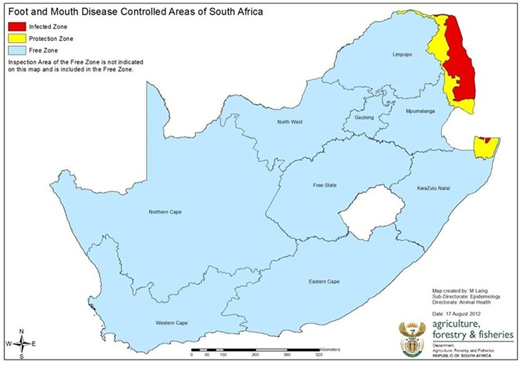
Figure 1: Foot and Mouth Disease Controlled Areas of South Africa
The Animal Diseases Act 35 of 1984 and the policies from the Department of Agriculture, Land Reform and Rural Development (DALRRD) govern the dos and don’ts, especially around animal movements, vaccinations, and outbreak responses.
Know your farm’s zone for better biosecurity
Understanding your farm’s zone classification is very important in tailoring your farm’s biosecurity game plan.
1. Lock down your farm perimeter: A well-protected farm starts at the gate
• Fence your boundaries to stop stray animals from wandering in.
• Use one clearly marked entry point for people and vehicles.
• Keep a visitor logbook. Track who’s been on your farm, where they’ve been, and if they’ve had recent contact with other livestock. Try to limit unnecessary traffic on your farm.
• Disinfect all wheels and boots before anyone steps onto your property.
• Simple, visible controls send a strong message; this farm is serious about health and safety.
2. Control animal movement: FMD moves fastest when animals move carelessly
• Buy smart. Only source cattle from verified, FMD-free herds.
• Quarantine all new arrivals for at least 21 days. Watch closely for signs like lameness,
drooling, or mouth sores.
• Clean and disinfect livestock trucks and trailers before and after every use. Don’t take
shortcuts.
3. Hygiene is non-negotiable: People and equipment can carry the virus in
• Provide dedicated overalls and boots for staff and visitors.
• Set up footbaths and hand-wash stations at barn and parlour entrances. Ensure you are
mixing disinfectants at the correct ratios and using effective and approved products for
FMD.
• Don’t share tools or gear with neighbouring farms.
4. Keep wildlife at bay: Wild animals are natural FMD carriers, particularly cloven-footed animals
• Keep a solid, game-proof fence if your farm borders wildlife areas.
• Maintain a buffer zone, ideally 500 meters or more, between livestock and game.
• Don’t allow communal animals onto your pastures or land, especially in high-risk areas.
5. Watch your herd: Early detection can make or break your outbreak response and control
• Train workers to spot the signs: blisters, drooling, limping, reluctance to move or eat.
• Keep good herd health records and monitor production drops or temperature changes
where possible.
• Report anything suspicious immediately to your vet.
6. Audit yourself: Take a step back and look at your system
• How does your farm fair as far as biosecurity safety measurements? Take the time to
identify possible weaknesses and measures that can be implemented to improve them.
• De Heus uses a BioSecure Check to critically evaluate the potential risks on the farm. This
should be a repeated check to ensure that implemented strategies are being correctly and
continually followed.
7. Plan for the worst: Even the best-run farms need an emergency plan
• Prepare an isolation pen or pasture ready to contain sick or suspect animals.
• A written contingency plan should be shared with your team.
• Put together a contact list for your vet, animal health technician, and local authorities.
8. Teamwork: FMD prevention is a team effort
• Run regular training for staff and workers, making it practical and easy to understand.
• Talk to neighbours about your protocols. Sharing info makes everyone stronger.
• Join local or regional biosecurity networks or WhatsApp groups for updates and alerts. The
more connected and informed we are, the faster we stop FMD in its tracks.
Conclusion:
Foot and mouth is a farm-by-farm challenge that affects the entire farming community. Contact a De Heus representative to run through a BioSecure Check with you on the farm to help identify possible weak points and things to improve. With the right biosecurity protocols, early warning systems, and a culture of accountability, South African dairy farms can stay healthy, productive and resilient even in the face of FMD outbreaks.
Contact your local De Heus technical advisor to help you to protect your dairy herd from Foot and Mouth Disease - https://www.deheus.co.za/meet-our-team/.


