
The Purpose and Principles of Good Wool Classing A Business Approach to Technical Excellence
Wool production is one of South Africa’s oldest agricultural industries, with a long-standing reputation for quality and global demand. Yet, the true value of wool lies not only in raw production but in how it is classed. Good wool classing forms the bridge between the farm and the market – a process that directly impacts a producer’s financial return. This article explores the purpose, technical principles, and financial benefits of professional wool classing.

This article explores the purpose, technical principles, and financial benefits of professional wool classing.
1. Nutrition and its impact on wool
Nutrition plays a critical role in wool growth, fibre quality and ultimately the economic value of the clip. Because wool is a continuously produced, protein-based fibre (±70% keratin), any fluctuation in the animal’s nutrient supply will have a direct impact on fibre diameter, strength and overall yield.
Nutrition and wool break (tender wool)
Wool break or “tender wool” occurs when the fibre becomes weak and susceptible to breaking along the staple. This thinning of the fibre is almost always linked to nutritional stress.
Primary nutritional causes of wool break
• Energy deficiencies (drought, poor grazing, sudden feed restriction)
• Protein shortages, especially of sulphur-containing amino acids (methionine and cysteine)
• Parasite pressure that reduces nutrient uptake
• Sudden dietary changes that disrupt rumen function
Production impact
• Lower clean fleece yield
• Shorter staple length
• Increased short fibre percentage (carding wool)
• Downgrading of wool class → significant loss in value
Nutrition’s influence on micron and wool yield
Micron sensitivity to nutrition
When nutrition is high:
• Fibre diameter increases (coarser micron)
• Wool yield increases
• Staple length improves
When nutrition is low:
• Micron decreases (finer), but often due to stress
• Wool yield drops sharply
• Risk of tender wool increases
Note: A small decrease in micron is not always bad, but an inconsistent fibre diameter is heavily penalised in wool classing.
The critical concept: nutritional stability
- High wool profitability comes from consistency, not extremes.
- Stable energy supply → consistent fibre diameter
- Adequate protein supply → strong, elastic fibres
- No sudden drops in diet quality → no weak points
- Balanced micron + maximum yield → highest income per hectare
The aim is not to produce the finest wool possible, but rather to achieve the most consistent wool with the highest total yield.
2. What is wool classing – and why does it matter?
Wool classing refers to the process of sorting raw wool into groups based on specific quality characteristics such as fineness (micron), length, strength, colour, elasticity, and contamination (foreign matter). This sorting not only determines the market value of the wool but also affects processing efficiency and end-use performance.
The core purpose of classing:
• Create a consistent, homogeneous product for buyers
• Maximise the value of every wool clip
• Build trust in the South African wool industry
Well-classed wool attracts better prices because buyers are assured of predictable quality. This increases competition at auctions and opens doors to premium markets.
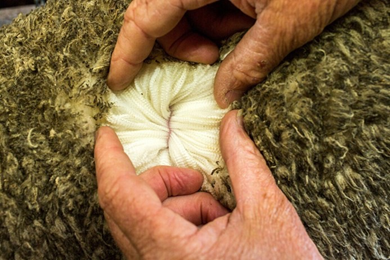
Figure 1: A good example of fine wool
3. Principles of good wool classing:
A skilled wool classer follows a set of established guidelines, as outlined in the South African Wool Classing Standards (set by Cape Wools SA):
a) Fineness (Micron): The most important price-determining factor. The finer the wool, the higher the value – especially for apparel production. Micron levels are measured electronically, but classers are trained to judge fineness by feel and sight.
Micron Impact on Price (Estimated Averages):
|
Micron Range |
Price (R/kg clean) |
% Premium vs 20–22 μm |
Supply Trend |
|
≤17 μm |
250–300 |
+40–70% |
Slightly lower |
|
18–19.5 μm |
200–230 |
+20–35% |
Steady |
|
20–22 μm |
160–180 |
— |
Broadest |
|
>22 μm |
130–150 |
–15–25% |
Declining |
Table 1: Impact of micron range on wool price and supply
b) Staple Length and Strength: Long, strong fibres are more valuable to spinning mills. Wool with weakness (tenderness) fetches lower prices. Good classers separate weak and strong staples early in the process.
c) Cleanliness and Colour: Bright, clean wool has greater processing potential. Contaminated wool (stained with paint, blood, or organic matter) must be removed. Good on-farm handling practices contribute greatly here.
d) Consistency: Buyers expect each bale to be uniform. Mixed-quality bales (with varying microns or lengths) lead to discounts or buyer hesitation.
e) Packaging and Labelling: Neat, well-labelled bales give a professional impression. All details – class, micron, farm info – must be clearly and accurately displayed.
4. The financial impact of professional wool classing:
According to Cape Wools SA, the difference between poorly and professionally classed wool can result in a 20–30% price variation per kilogram. In a season where wool sells at R150/kg, this means:
|
Item |
Poor Classing (R/kg) |
Good Classing (R/kg) |
Difference (R/kg) |
Total for 3 000 kg |
|
Wool Price |
115 |
145 |
+30 |
+90 000 |
|
Downgrade Loss (~5%) |
— |
−7.25 |
−7.25 |
−21 750 |
|
Net Gain per Clip |
— |
— |
+82.75 |
+248 250 |
Table 2: Impact of wool classing on revenue**
Even accounting for occasional downgrades, professional classing can result in a net gain of over R248,000 on a 3,000 kg wool clip.
**The figures in this example are provided for illustrative purposes only.**
Real-World example:
A 15.3 μm certified bale recently sold for R254/kg while the auction average was R173/kg — a 47% premium. In another case, a 14.3 μm bale achieved R300/kg, one of the highest prices in the past decade.
**Please note: The figures provided are examples intended solely for explanatory purposes**
Additional financial advantages include:
• Less wool being downgraded or withheld
• Enhanced producer reputation and buyer loyalty
• Buyers are more willing to bid again on known quality clips
• Wool brokers consistently confirm that farmers who invest in a professional classer more
than recover their costs
5. Training and Professionalisation:
Good classing requires both experience and training. Various institutions offer formal courses (e.g., BKB, OVK, Cape Wools SA). Certification of wool classers helps professionalise the occupation and gives producers peace of mind that their clip is in expert hands.
Tip for producers: Include shearers and farm workers in annual training – it builds understanding and cooperation toward quality goals.
Conclusion: It is more than sorting – It is smart farming.
Good wool classing is not just a technical step – it’s a strategic financial decision. By applying strict standards, classers help producers unlock the true value of their product, build brand identity, and strengthen their position in a competitive market.
In a time when every Rand counts, professional wool classing is not a cost – it’s an investment.
Learn how good wool classing can boost your business—contact your nearest De Heus Technical Specialist for guidance - https://www.deheus.co.za/meet-our-team/.


