
Water in Dairy Production: An Essential Overview
In dairy production systems, water intake, feed intake, and milk production are tightly linked. These factors do not act in isolation—each one drives and responds to the others, forming a continuous cycle that ultimately determines animal performance.

Within the normal physiological limits, there is a direct positive relationship between feed intake and water intake. But what factors affect these relationships? This article is the first in a series on water in dairy production. It provides an overview of the importance of water, setting the foundation for more practical discussions on water provision and water quality in the articles that follow.
Water is the single most important and essential nutrient, and therefore it is crucial to sustain the wellbeing (life and health) of ruminant animals. In the context of animal production systems and related animal wellbeing, water supplied to the animals should be safe from harmful chemical concentrations, microorganisms, and other contaminants.
When problems occur, drinking water quality should be assessed, the placement, size and management of water troughs should be investigated, as well as other factors known to affect water intake. Often, livestock producers and other livestock stakeholders have an insufficient understanding of water nutrition for animals, especially ruminants.
Why is water so important?
Water is the most important nutrient to sustain life, and for optimising growth, lactation and reproduction of dairy cattle. Despite the important role of water quality in animal production, in industry, water management of production systems is often not afforded as much attention as animal-related aspects, such as diet.
In dairy cattle, the intake of good-quality water plays an important role in the optimal utilisation of diets, which in turn will be evident in optimal health and milk production. Thus, it is important that the quality of water provided to animals should be regularly evaluated to ensure good production.
The water requirement per unit of body mass of a high-producing dairy cow is greater than that of any other land mammal. This is because milk is made up of 87% water. Water regulates several functions within cattle, including the transport of nutrients within the body, proper fluid and heat balance, cushioning for a developing foetus, excretion of waste (urine and faeces), digestion, etc. An adult dairy cow will have a total bodyweight consisting of between 56-81% water, depending on the stage of lactation.
Water intake:
Free water intake (the amount of water a cow drinks voluntarily when she has unrestricted access to clean, fresh water) by dairy cows makes up 80-90% of their total water need. Cow size, milk yield, quantity consumed, dry matter from feed, relative humidity, temperature, water temperature, and the amount of moisture present in feed determine the amount of water consumed by a cow. During periods of heat stress, water is a crucial nutrient, as the physical properties of water allow heat to be transferred from the body to the environment. On the contrary, during cold stress, body heat is conserved through the heat capacity of body water, which acts as insulation.
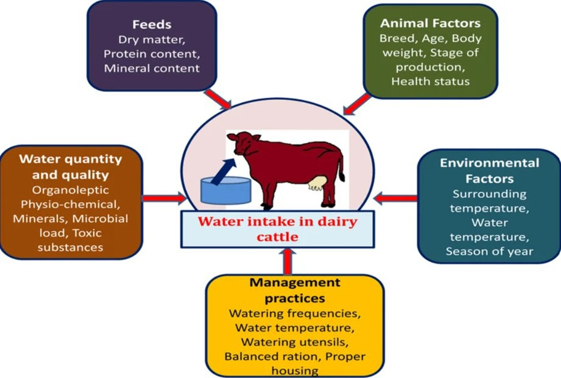
If water intake is limited, even slightly, dry matter intake will decrease by 0.5 to 1 kg daily, which could in return decrease peak milk production by 1 to 2.3 L. Lactating dairy cows require 1.8 to 2.3 L of water to produce 0.5L of milk. Daily water intake is made up of both the moisture consumed in the ration, as well as drinking water. For example, a cow eating 36.3kg of a ration containing 40% moisture will consume 14.6L water. Several factors influence the drinking behaviour of a cow, including ease of water access, water temperature, whether water is given in a water bowl or trough, eating patterns, and cow dominance.
Water temperature: Cattle prefer water at 10-20°C. Water intake may increase when cows are provided with cool water under hot conditions, and it can provide some short relief from the heat as water absorbs body heat. In the case of air temperatures rising above 27°C, water intakes might be higher, or when temperatures fall below 10°C, water intake might be lower than expected and even much less in the case of very low temperatures.
Eating pattern: During periods when feed intake is at its greatest, cow water intake will peak. Cows tend to alternate between consuming feed and drinking water when given the opportunity. Thus, it is ideal to have fresh, clean water available to cows whenever she consumes feed. In addition to this, cows seek water after milking. In the areas where cows pass after milking, it is advised to have available water sources.
Cow dominance: Submissive cows tend to visit water points less than other, more dominant cows drinking from the same source. Thus, social interactions are of great importance for producers with cows sharing watering points.
Other reasons for a reduction in water intake in dairy cattle:
• Lack of water supply to drinking devices. Might be due to corroded valves.
• Inadequate access to water troughs. Might be due to poor placement.
• Inadequate pressure in watering systems.
• Poor chemical water quality.
• Pollution - Chemical or bacterial.
Water quality and the effect on dairy cows:
When discussing water on dairy farms, the focus is often placed on quantity. However, quality is just as important, if not more so. Water quality refers to the physical, chemical, and biological characteristics of water. This includes factors such as mineral content, pH, temperature, and microbial contamination. Importantly, water quality cannot be judged by appearance alone. Clear water is not necessarily clean or suitable for consumption, and contaminated water does not always appear dirty. This is one of the biggest challenges in managing water on the farm—producers often rely on visual assessment, which can be misleading.
There are several factors that determine water quality and influence whether cows will consume enough. While these factors are often evaluated separately, they are closely interrelated and together determine the suitability of water for dairy cattle.
Palatability: Palatability is one of the most important, often underestimated, aspects of water quality. Cows are sensitive to the taste and smell of water, and any unpleasant characteristics can reduce intake. Water that is contaminated with organic material, algae, manure, or high mineral concentrations can quickly become unpalatable. Even if the water is technically safe, reduced palatability may lead to lower intake and, consequently, reduced production.
Total Dissolved Solids (TDS): TDS represent the total concentration of dissolved substances in the water, primarily consisting of inorganic salts and small amounts of organic matter. TDS is often used as a general indicator of water quality, as it reflects the overall mineral load in the water. As TDS levels increase, water may become less palatable, particularly when salinity is high. Elevated TDS levels have been associated with reduced water intake and, in some cases, decreased animal performance. However, TDS alone does not indicate which specific minerals are present, and further analysis is often required to fully assess water quality.
Mineral Composition: While TDS provides an overall indication of mineral content, the specific minerals present in the water are equally important. At acceptable levels, many minerals do not pose a problem and may even contribute to the animal’s mineral intake. However, excessive concentrations can negatively affect both intake and animal health. It is therefore important not only to consider the total mineral content, but also the balance and concentration of individual minerals present in the water.
pH: The pH of water indicates whether it is acidic or alkaline. While dairy cows can tolerate a relatively wide pH range, extreme values may reduce palatability and potentially impact rumen function. Highly acidic or highly alkaline water can influence microbial activity in the rumen and may also affect the effectiveness of certain water treatments or medications. Maintaining water within an acceptable pH range is therefore important for both intake and overall animal health.
Microbial Contamination: Microbial quality is another critical component of water quality. The presence of bacteria such as E. coli is commonly used as an indicator of faecal contamination. Contamination can occur through polluted water sources, poorly maintained troughs, or environmental exposure. Water that is contaminated with microorganisms may reduce intake due to poor taste and odour, and in some cases, pose health risks to the herd. Regular cleaning of troughs and monitoring of microbial quality are therefore essential components of good water management.
Conclusion:
In practice, water should not only be available in sufficient quantities, but it should also be of a quality that supports optimal intake and animal performance. Because water quality cannot be accurately assessed by appearance alone, regular testing and monitoring should form part of routine farm management. By testing water, De Heus Technical Advisors can ensure that mineral levels are balanced and safe, supporting both intake and overall animal performance.
Ensuring proper water management on the farm helps maintain feed intake, supports rumen function and ultimately improves milk production and animal health. In the next article, we will focus on the practical aspects of water provision on the farm, including trough design, placement, accessibility, and how these factors influence drinking behaviour and performance.
Keep an eye out for the next article in this water series, where we will explore water quality in detail, with a specific focus on parameters such as total dissolved solids (TDS), mineral composition, and microbial contamination, and their practical implications on dairy production.
Contact your local De Heus technical advisor to assist with why water in dairy production is an essential overview - https:// www.deheus.co.za/meet-our-team/.


