
Feed structure for chickens: Why does it matter?
When producing poultry feed, the goal is to produce a predictable and constant feed to meet market and animal requirements in terms of both nutrients and physical structure. The physical structure of feed is very important in chicken nutrition because it influences feed intake, digestion and consequently production performance.

Feed structure can be differentiated by both microstructure and macrostructure qualities, as defined in the table below.
|
Term |
What it means |
Why it matters |
|
Microstructure |
Intrinsic granulation of each ingredient, especially ground raw material particles (e.g. maize particle size) |
Directly modulates gizzard activity, starch/protein digestibility & gut health. |
|
Macrostructure |
Final physical form of the complete feed: pellet or crumble diameter /length, percent fines, pellet durability |
Determines voluntary feed intake, potential nutrient/ingredient segregation losses |
Table 1: Feed structure terms
The microstructure (raw material particle size) affects the macrostructure quality for multiple parameters, such as dust, uniformity, particle size, pellet durability, and hardness. Colour, smell and taste can also be affecte
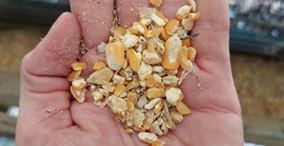
d by the physical structure and processing of the feed. Feed structure and particle size affect how every raw material in poultry feed is digested.
Chickens’ preference for physical structure depends on age. Younger birds prefer smaller particles and can struggle to ingest large particles such as whole maize or pellets. If the maize particles of mash feed are too coarse, young layer hens coming into peak production may select around these particles, as seen in the picture on the right.
The importance of the coarse-to-fine particle ratio in feed for both the intakes and physiological development of chickens cannot be underestimated. Coarse particles in the feed stimulate the gizzard. As a result, the size of the gizzard increases and digestion improves. Whereas if the feed is ground too finely, the fine particles can slip through the upper digestive tract without activating the gizzard. Even in pelleted feed for broilers, it has been proven that feeding coarser raw material particles, such as soybean meal, results in the development of heavier gizzards, improved feed efficiency and improved carcass yield in some cases.
Another example of the importance of physical microstructure for digestion is the use of coarse limestone for layer hens. It takes the layer more time to digest and absorb the coarse limestone particles than the fine particles. Therefore, the digestion of coarse limestone particles results in a slow and steady release of calcium in the blood. This is beneficial because it takes a long time for the eggshell to be formed, during which a constant supply of calcium from the blood is needed. However, the finer particles of feed also contain very important nutrients, such as minerals and vitamins, and fine limestone is available to hens more quickly via faster digestion and absorption.
Mash vs. Pellets vs. Crumbles: Which one to choose and why?
Chicken feed can be presented in different physical macrostructures: mash, pellets and crumbles. Pellets are eaten the fastest, mash the slowest and crumble in between. The choice of feed structure is not only determined by chickens’ requirements, but also by market preferences, farmer requirements, production aim, availability of raw materials, local environmental conditions, availability of production technology, transport, and costs. The chicken species that are being farmed often determines the main choice for feed form. Layer hens need access to feed ad libitum, so a mash form is typically recommended to prevent excess weight gain. In contrast, broilers need to grow quickly to meet production parameters, and pellets are ideal to increase intakes.
Mash feed:
Mash feed is produced by mixing and milling raw materials into a homogenous mash. Mash feed has lower production costs and coarser particles that improve digestion, with the microstructure primarily determined by the raw materials and production process when milling the feed. Important factors to consider with mash feed include the homogeneity and flowability of the feed (especially in silos and transport) and the limitation of dust (fine particles of < 0.5 mm) and extra-large particles (> 4 mm). Homogeneity of mash feed is much more important for transport in bulk than in bags. If the mash feed structure is not homogenous, it could potentially de-mix in the bulk truck during transport, and in the feeding system on the farm.
Practically, a disadvantage of mash feed is the chance of selective feeding, where either the fine or coarse particles are eaten first. To prevent chickens from selectively feeding, it is important to check whether there are still enough coarse components in feed troughs 10 minutes after feeding. Components of different particle sizes should be evenly distributed throughout the feed troughs to prevent selection. The type of feeding system also has an impact; a fast-moving chain feeder can prevent hens at the front of the chain from selecting all the coarse components, while such prevention is much more difficult in manual feeding. Mash feed may be considered less hygienic as there is no heat treatment to kill bacteria. Feed intake and growth are also slower when feeding a mash compared to crumbles or pellets. However, the lower and more regulated feed intake of mash feed can be advantageous when it is necessary to slow down growth in growing pullets and broiler breeders.
Pelleted feed:
Pelleted feed is produced by using pressure and steam to agglomerate mash into pellets. The pellet can be produced in different diameters and different lengths. Both the diameter and length of the pellets can be increased as chickens get older. Coarse particles can be provided not only in mash feed, but also in a crumble or pellet. By paying attention to the microstructure of the mash. Feed before pelleting, the internal structure of a pellet can provide coarse particles to stimulate the gizzard. For fast-growing broilers, a crumble and/or pellet is preferred since the aim is to stimulate feed intake and maximize growth, efficiency, carcass weight and ultimately profitability.
The advantages of pellet versus mash are faster intake, possibly improved hygiene due to heat treatment, a fixed composition and reduced feed wastage. Spillage is reduced by feeding pellets and may be preferable in a free-range farm where chickens often tend to scratch and spill their feed. Fast feed intake is important for fast-growing broilers, and under certain circumstances, such as heat stress, when intakes would typically be lower. No segregation of raw materials occurs with pelleted feed.
A disadvantage of pellet versus mash is the higher production costs. Pellets are also typically not suitable for young chicks in the starter phase, as they are too large to be consumed. The durability of pellets affects the quality - effects of low pellet quality are somewhere between responses with mash and pelleted feeds.
Crumbled Feed:
Crumbles are produced by breaking pellets with a crumble machine. Particle size distribution in crumble feed is important and depends on age. Younger chicks prefer smaller crumble particles than older birds. The picture on the left shows a fine crumble (top right) typically suited to a Pre-starter ration for the first few days after placement, while a coarser crumble (left) may be better suited for a Starter ration once the chickens have adapted. Both can be suitable depending on the farm and animal requirements. The particle size of the crumble is typically larger as the bird increases in age. For a crumble, particle size distribution is important for optimal results, as all crumble rations are expected to have a mixture of finer and coarser particles in a batch. Advantages of crumble versus mash are a faster intake, improved feed safety and digestibility due to heat treatment, and a fixed composition. Crumbled feed intake time is between mash and pellets.
A disadvantage of crumble versus pellet is that there is a chance of selective eating by the birds. The picture on the right shows an example of a poor-quality crumble where the pellets were not properly broken down into crumbles, resulting in selective feeding as the young chicks are not able to consume the large pellets. The opposite can also occur, where crumble or pellet durability is too low, and the particles break down in the feeding system, negatively impacting feed intakes and growth in broilers. Production cost is also higher for a crumble versus a pellet and mash due to extended production time.
Conclusion:
Animal nutritionists can design and produce the best feed in terms of nutrients and raw materials, but when the feed structure is not good or consistent, it does not make sense. Feed intake is important to fulfil nutritional needs; no intake means no nutrients. The micro- and macrostructure of feed plays a crucial role in the intake, digestion, efficiency and ultimately performance of the feed and chickens. Knowing the influence of feed structure characteristics will help determine the best choice for the breed of chicken, environmental conditions, management and production goals of each specific farm. The correct feed structure choice can make the difference between struggling to meet goals and achieving optimal production performance in chickens.
Should you require more information relating to feed structure for chicken, please contact your nearest De Heus Technical Specialist - https://www.deheus.co.za/meet-our-team/.


