
Natural Power in Broiler Production: A Holistic Approach to Chick Placement and Early-Life Management.
Modern broiler production is built on the principle of efficiency, where optimal growth, uniformity, and profitability are achieved through precise management of birds from the earliest stages of life. Among all production phases, the brooding period, covering the first 7 to 14 days is the most critical, as it lays the foundation for the bird’s future performance. During this time, chicks undergo rapid physiological development and must adapt quickly to their environment. Any shortcomings in management during this phase can have long-lasting negative effects on growth rate, feed efficiency, and mortality.

The De Heus concept of Natural Power, developed within animal nutrition and production systems, provides a holistic framework for managing broiler chicks during this sensitive period. It is based on the integration of three core pillars: nutrition, management, and health. These pillars collectively ensure that animals are raised in environments that support both welfare and productivity. Healthy animals are more efficient, require fewer inputs, and contribute to more sustainable production systems. When applied to broiler chick placement and brooding, Natural Power emphasizes the importance of aligning environmental conditions, feeding strategies, and biosecurity measures to create an optimal start for the flock.
The Concept of Natural Power in Poultry Production
Natural Power is founded on the understanding that animal performance is not driven by a single factor but by the interaction of multiple systems. Nutrition ensures that chicks receive the necessary nutrients for rapid growth and development, management provides the environmental conditions required for comfort and efficiency, and health focuses on disease prevention and immune system support. These three components are interdependent and must be optimized simultaneously to achieve the best results.
In broiler production, this integration becomes particularly important during the brooding period. At this stage, chicks are highly sensitive to environmental and nutritional changes, and even small deviations from optimal conditions can lead to significant performance losses. For example, poor feed availability may reduce growth, while inadequate temperature control can suppress immune function.
The Natural Power approach recognizes that success depends on managing all these factors together rather than in isolation.
Biosecurity as a Foundation for Health
Biosecurity forms a critical component of the Natural Power framework, particularly within the health pillar. The preparation of the poultry house before chick placement plays a decisive role in preventing disease and ensuring a healthy start for the flock. Effective cleaning and disinfection procedures must be carried out thoroughly and systematically to remove organic matter and eliminate pathogens.
The cleaning process involves both dry and wet cleaning stages, followed by the application of disinfectants. Organic material left in the house can reduce the effectiveness of disinfectants, allowing harmful microorganisms to persist. In addition, a rest period between flocks is essential to break disease cycles and allow the environment to stabilize.
Biosecurity also extends to personnel and equipment. Individuals handling chicks during placement must follow strict hygiene protocols, including wearing clean clothing and disinfected footwear, to prevent the introduction of pathogens. By maintaining high biosecurity standards, producers can significantly reduce disease challenges, thereby improving both animal welfare and production efficiency.
Chick Placement and the Importance of a Good Start
The placement of day-old chicks into the broiler house marks a critical transition from the controlled conditions of the hatchery to the farm environment. At this point, chicks must quickly adapt to their surroundings, locate feed and water, and begin developing their immune and digestive systems. The success of this transition is determined by how well the house has been prepared and how effectively management practices are implemented during the first few hours after placement.
A commonly used indicator of successful brooding management is the body weight achieved at seven days of age. Ideally, chicks should reach approximately four times their initial body weight within this period. This reflects adequate feed and water intake, proper environmental conditions, and minimal stress. If chicks fail to reach this target, it often indicates underlying issues in pre-placement preparation or early management.
Chicks are particularly vulnerable at placement because they are unable to regulate their body temperature effectively and rely heavily on external heat sources. In addition, their energy reserves are limited, making early access to feed and water essential. Stress experienced during this period may not immediately be visible but can manifest later as poor growth, uneven flock development, and increased mortality. This highlights the importance of providing a well-prepared environment that supports rapid adaptation and minimizes stress.
Water Management and Its Role in Early Growth
Water is often overlooked in broiler production, yet it is the most important nutrient during the early stages of life. Chicks require immediate access to clean, cool and fresh water upon placement, as this stimulates feed intake and supports metabolic processes. During the first week, water consumption is typically two to three times higher than feed intake, emphasizing its importance in early growth.
Effective water management involves ensuring that drinkers are correctly positioned and functioning properly. At placement, a small droplet of water can be visible at the end of each nipple drinker to attract chicks and encourage drinking. The height of the drinkers must be adjusted to match the chicks’ size, initially at eye level and gradually raised as they grow. Water pressure must also be carefully controlled to prevent both spillage and insufficient supply.
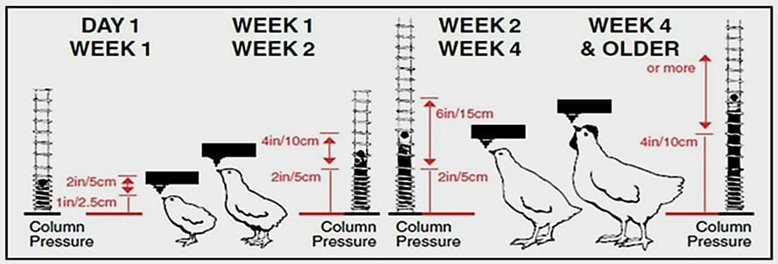
Figure 1: Drinker height and water pressure management across broiler growth stages
Figure 1, (Breeder Management Guide, Cobb) provides a guide on how the drinker height, along with the water pressure, should be managed during the life cycle of a broiler.
Monitoring water intake provides valuable insights into flock health. A sudden decrease in consumption is often the first sign of a problem, such as a disease or environmental stress. Maintaining optimal water quality and availability is therefore essential for supporting both nutrition and overall flock performance.
Feed Management and Early Development
Feed management during the brooding period is closely linked to water intake and plays a crucial role in determining growth and uniformity. Newly placed chicks must quickly learn to locate and consume feed, as this supports the development of the digestive system and promotes rapid weight gain.
To facilitate this process, feed should be provided in a form that is easy to consume, such as a fine crumble. Supplementary feeding methods, including the use of paper or trays, help ensure that feed is readily accessible and visible to chicks. These methods also stimulate natural feeding behaviour by encouraging movement and exploration within the brooding area.
Figure 2: Application of chick paper.
Figure 2, shows the practical implementation of chick paper to ensure feed is accessible and visible to chicks. The success of feed management can be assessed through crop fill evaluation. Within the first few hours after placement, most chicks should have crops that are full and soft, indicating that they have consumed both feed and water. A guideline for this crop fill evaluation:
• After 8 hours, a minimum of 80% of them should have feed and water in the crop.
• The morning after placement, 95% of the chicks should have feed and water in the crop.
If this is not achieved, it may signal issues with feed availability, water access, or environmental conditions. Early feed intake is directly linked to weight gain and flock uniformity, making it a key component of the Natural Power approach.
Environmental Control: Temperature, Humidity, Air Quality, and Ventilation
Environmental management is one of the most important aspects of broiler production, as it directly affects chick comfort, health, and growth. Temperature control is particularly critical during the brooding period, as chicks are unable to maintain their body temperature independently. The house must be pre-heated before placement to ensure that both air and floor temperatures are within the recommended range. A floor temperature of at least 28° C is essential to prevent heat loss through the chicks’ feet, which can lead to chilling and reduced activity.
Humidity works together with temperature in maintaining the optimal chick comfort and can affect the recommended temperature. Relative humidity registered at 60%, which is optimum for chicks during the brooding period, will require a temperature of 30-31°C. Higher relative humidity will increase the “real feel” temperature, thus requiring a lower temperature set point. While lower relative humidity can result in a cooler “real feel” temperature, requiring a higher temperature set point. Table 1, (Ross Broiler Management Handbook, 2025) demonstrates the recommended temperature set points at different relative humidity increments and body weight.
Table 1: Broiler temperature guidelines by humidity and body weight (Ross, 2025)
Air quality and ventilation are equally important. Proper ventilation ensures the removal of harmful gases such as carbon dioxide and ammonia while maintaining adequate oxygen levels. It also helps distribute heat evenly throughout the house. However, ventilation must be carefully controlled to avoid drafts, as young chicks are highly sensitive to air movement. Poor air quality and ventilation can lead to respiratory problems, reduced growth, and increased mortality.
Environmental stressors, including temperature fluctuations and inadequate ventilation, can have significant negative effects on chick welfare. Maintaining stable and optimal environmental conditions is therefore essential for supporting the health and performance of the flock. Figure 3, (Arbor Acres broiler management handbook, 2025) displays the visual behaviour of broiler chicks during specified environmental conditions.
Figure 3: Broiler chick behaviour under different environmental conditions (Arbor Acres, 2025)
Lighting Management and Behavioural Development
Lighting plays a vital role in regulating chick behaviour and promoting early development. During the first 24 hours after placement, continuous lighting is recommended to encourage chicks to locate feed and water. This initial period of constant light helps stimulate activity and ensures that chicks establish feeding and drinking patterns quickly.
After the first day, a gradual introduction of darkness until you reach 4 – 6 hours of darkness by day seven is beneficial for improving feed efficiency and promoting normal behavioural patterns. Light intensity must also be carefully managed to ensure even distribution throughout the house. Uneven lighting can lead to clustering and uneven feed intake, which negatively affects flock uniformity. Avoid continuous extended dark hours; split the dark period into two sections within the 24 hours, for example, implementing 8 hours of darkness.
Inappropriate lighting conditions can act as a stressor, disrupting feeding behaviour and sleep patterns. By implementing a well-structured lighting program, producers can enhance both the welfare and productivity of broiler chicks.
Stress Management in Modern Broiler Production
Modern broiler production systems expose chicks to a variety of stressors, including high stocking densities, environmental fluctuations, and handling during transport and placement. These stressors can weaken the immune system, reduce feed efficiency, and increase susceptibility to disease.
Stress management is therefore an essential component of the Natural Power approach. By providing a stable and supportive environment, minimizing handling, and ensuring consistent access to resources, producers can reduce stress levels and improve overall flock performance. Addressing stress during the early stages of life is particularly important, as its effects can persist throughout the production cycle.
Conclusion
The successful placement and brooding of broiler chicks requires a comprehensive and integrated approach that addresses all aspects of the production environment. The De Heus Natural Power concept provides a valuable framework for achieving this integration by combining nutrition, management, and health into a unified strategy.
By focusing on key factors such as biosecurity, water and feed management, environmental control, and lighting, producers can create conditions that support optimal chick development and minimize stress. The brooding period represents a critical window of opportunity to influence the future performance of the flock, and careful attention to detail during this stage can yield significant long-term benefits.
In conclusion, Natural Power is not merely a theoretical concept but a practical approach that aligns all elements of broiler production to achieve healthier birds, improved efficiency, and sustainable outcomes. For more information, contact your local De Heus Technical Advisor - https://www.deheus.co.za/meet-our-team/.


