The root cause is often not nutrition or genetics but poor flock uniformity at transfer. What happens during rearing ultimately determines whether your eggs grade consistently or cost you money.
1. Uniform Birds, Uniform Eggs = The Foundation of Profitability
Flock uniformity measures how closely birds match the target body weight for their age. Expressed as the percentage of birds within +/-10 % of the average body weight, a good flock should achieve at least 85% uniformity or higher at transfer.
2. Why does this matter?
Uniform birds respond to light at the same time, reach the onset of laying together, and produce eggs of similar size, while non-uniform birds do the opposite, resulting in mixed egg sizes, inefficient grading, and lost income.
2.1 Factors affecting bird uniformity and egg grading
|
Factor
|
How It Affects Flock Uniformity
|
Impact on Production
|
|
Housing
|
Poor brooding conditions create different environmental zones and early growth gaps that never fully recover.
|
Uneven bird development and inconsistent egg sizes
|
|
Feed Competition
|
Limited feeder space allows dominant birds to thrive while weaker birds fall behind.
|
Increased body weight variation and poor uniformity
|
|
Inconsistent Feed Quality
|
Variations in nutrients or particle size result in uneven intake and growth.
|
Irregular maturity and egg size distribution
|
|
Water Issues
|
Uneven access or pressure differences quietly affect flock performance
|
Reduced feed intake and uneven growth
|
|
Stocking Density
|
Crowding increases stress and competition
|
Lower uniformity and delayed onset of lay
|
|
Health Challenges
|
Even mild or uneven disease pressure creates growth
variability
|
Poor performance and inconsistent egg grading
|
2.2 Combined Effects
Any of or a combination of the above factors has a synergistic effect on the growth uniformity of the hens, which
results in poor uniformity of the hens at the point of lay.
3. The House Record Card Before Lay
Flock weight monitoring and health history are more than routine records, important elements of a performance forecast.
3.1 What Rearing Data Tells You
Consistent body weight tracking during rearing reveals whether birds are developing uniformly and reaching breed standards. Hens that grow slightly above the standard curve without becoming overweight typically enter lay with stronger body reserves. The result is stable production and eggs that consistently fall within correct grading categories.
3.2 Risks of Poor or Inconsistent Record Keeping
Bird performance in laying cannot be guaranteed, and most commonly, flocks with uneven growth or birds falling below standard weight and development often struggle with delayed and uneven onset of lay. This leads to a wide spread of egg sizes, particularly an increase in small and rejected eggs.
3.3 A Detailed House Card
A well-managed rearing farm should provide:
• Weekly body weight records
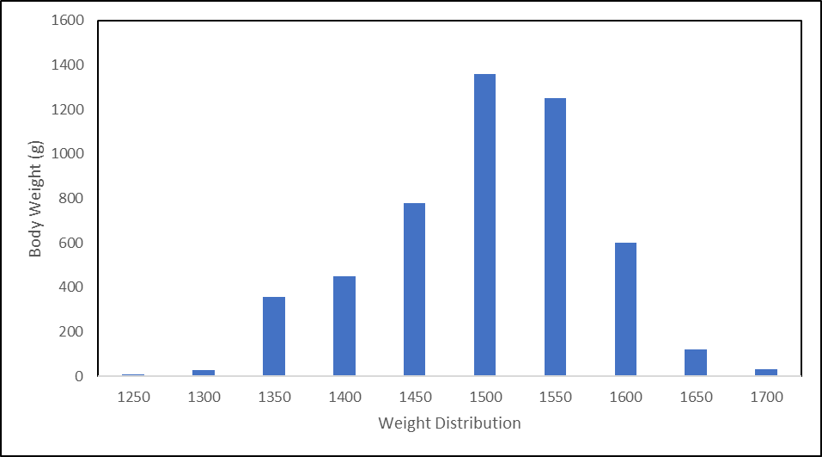
• Weight distribution and coefficient of variation (see figure 1)
• A complete health history (including vaccinations)
• The lighting programme up to 16 weeks and beyond
These are not just records; they are tools that allow producers to predict grading outcomes and adjust management before problems arise.
4. Pullet Development and Uniformity in Practice
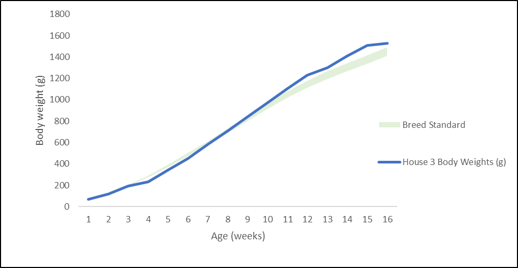
Figures 1 and 2 show a typical example of a flock that was fed a De Heus Excel Layer range from starter, grower, and developer at rearing. This flock was consistently above minimum breed standards while maintaining excellent uniformity of above 90% at 15 weeks (Figure 1).
Fig. 1: Example of weight distribution to show flock uniformity
Fig. 2: Growth curve of Hyline Silver Pullets at Farm X (KZN, South Africa)
Figure 2 shows a positive and consistent rearing performance, with body weights tracking above the minimum standard and close to breed targets from around 6 weeks onward.
4.1 Early Rearing Phase
During the first 4 weeks, birds started slightly below target but recovered quickly by week 6. This indicates good brooding management and effective early correction. From weeks 6 to 12, growth remained steady and consistent, suggesting strong rearing management conditions such as:
• Good feed intake
• Adequate feeder space
• Stable environmental conditions
• Strong flock health
4.2 Late Rearing Phase
During the developer period (12 to 16 weeks), birds continued tracking above minimum standards without becoming overweight. This supports uniform sexual maturity and controlled egg size development, which are key for consistent egg grading. Such growth patterns typically result in synchronized onset of lay and a tighter egg size distribution. Birds entering the laying phase with this level of uniformity are more likely to produce a higher proportion of medium-to-large eggs earlier in production, improving grading efficiency and overall profitability.
5. The Transition Phase
This is where profits are made or lost. Moving birds from rearing to the laying house is a critical turning point. At
this stage, body weight and physiological readiness determine how birds respond to light stimulation.
Expect the following:
• Underweight birds: Late starters, small eggs, prolonged catch-up.
• Overweight birds: Early layers, oversized eggs, shell quality and prolapse risks, quick to get out of lay.
• Non-uniform flocks: All sizes at once, small, medium, and large eggs, as well as a lower and often delayed peak.
These inconsistencies directly reduce grading efficiency, increase sorting costs, and lower overall returns.
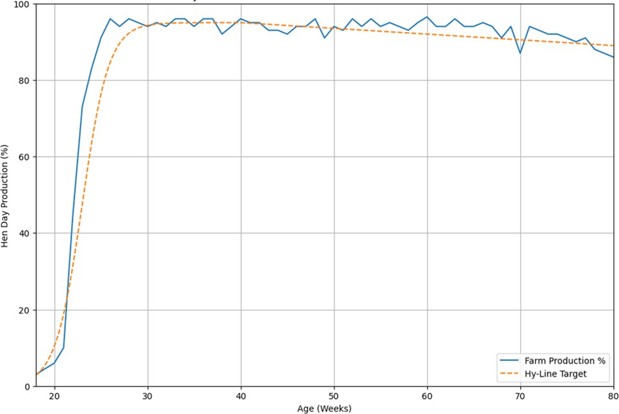
As an example, Farm X rears its own pullets to ensure that they have better control over the outcomes of the latter. Birds are transferred while given 14 hours of light during the last week of rearing and are subjected to similar lighting, though stimulation to reach 16 hours of light happens quite rapidly at the laying shed.
Figure 3: Farm X’s performance vs Hyline production curve
Figure 3 demonstrates excellent flock uniformity at transfer, with birds reaching peak production rapidly and maintaining high persistence above 94% for an extended period. Such performance is typically associated with well-managed rearing, consistent body weight uniformity, and good flock health history. This level of production stability generally translates into improved egg grading consistency, with a higher proportion of large and uniform eggs throughout peak production.
6. Expected Grading Outcomes
Based on the strong growth pattern and excellent flock uniformity, good egg grading performance can be expected throughout the laying cycle. Birds entering production with adequate body reserves and uniform development typically produce consistent egg sizes and improved grading efficiency.
The goal is not just to produce the greatest pullet weights but eggs that pay better.