
Water management in poultry: a key to enhancing Natural Power
Water is often an overlooked nutrient in poultry production, whereas emphasis is typically put on environmental conditions, feed, lighting and animal health. While many producers are aware of the importance of supplying water, water management and quality are not a daily focus on the farm. Chickens will consume approximately double the amount of water compared to feed. Water directly affects feed intake, production and animal health. It is a vital component of many physiological processes such as nutrient digestion and absorption, excretion, metabolic processes, muscle formation, egg formation and thermoregulation. Good water management and quality play a major role in both health and nutrition.

Efficient production is essential for agriculture, especially in recent times where produce markets are volatile. The De Heus concept of Natural Power emphasises the fact that healthy, “happy” animals will produce more efficiently with lower inputs and associated costs. The key pillars of Natural Power are nutrition, health and management. If we can provide the right nutrition for the right phase of an animal’s life, keep diseases off the farm through improved biosecurity, improved animal health and responsible use of antibiotics as well as provide the optimal environment for the animal through good management practices - we will support the animal’s ability to naturally produce well and reduce the reliance on antibiotics, medications and other costly interventions. Focusing on these pillars will lead to a reduced reliance on intervention strategies with a shift to prevention strategies. Water management is an important tool in boosting Natural Power. It is essential to maintain clean, accessible and high-quality water - good water management practices can assist in this. Good water management can aid in supporting the bird’s natural ability to produce well, optimising production and performance while improving animal health and welfare.
Accessibility and availability
First and foremost are water accessibility and availability, whether water is accessible and available to all chickens at all times. A water shortage of 24 hours to 48 hours can result in a 4 % loss of production that could last as long as two weeks in some cases. Not only will this affect production, but it will also affect egg and shell quality. Water deprivation results in increased cracks through thinning of shells and can also affect egg size, resulting in smaller eggs. As we know, feed intake and water intake are related; water deprivation can significantly hamper feed conversion ratio (FCR) values and decrease average daily gain, especially in young broilers.
When water consumption is uneven within a flock, uniformity could be negatively affected, and production could suffer. Water deprivation may also affect meat quality, leading to increased enzyme levels and a decrease in intermuscular fat and thickness of the breast cuts. Water-deprived broilers have also been shown to have paler meat. Not only does water deprivation influence production, but it also has serious consequences on animal health. A reduction in antibodies used to fight viruses could result from water deprivation. Deprivation can also lead to lesions in the gizzard, visceral gout and ulceration of the lower intestines.
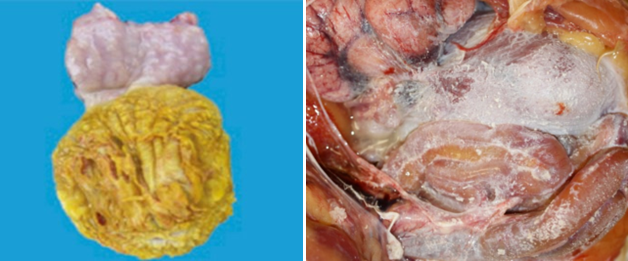
Figure 1: Gizzard erosion/ lesions (left) and visceral gout (right)
Water deprivation affects chicken welfare and behaviour. Chickens deprived of water will reduce feed intake and can be more excitable and unsettled. When water is reintroduced, aggressive behaviours such as feather, vent and toe pecking have been noted as well as excessive water intake and competition for drinkers.
Figure 2: Overcrowding at drinkers (left) compared to regular drinking behaviour (right)
As can be seen from the above, it is crucial to check daily that there is indeed water flowing in the water lines in the shed. It cannot be assumed that because the taps are open and the pumps are on, there is water available to the birds. Water should be available from each and every drinker in a shed – especially in cage systems where birds cannot choose to move to another drinker. During shed walkthroughs, staff should check whether drinkers are operational – ideally, this should be done by physically checking whether the drinkers are functional. Chicken behaviour should also be monitored. In caged layer systems, note whether the birds appear dehydrated – lethargic, dry, shrivelled or floppy combs and wattles, sunken eyes, panting, etc.; if there is an excessive amount of feed in the troughs, whether the manure is excessively dry, do you observe the chickens actively eating and drinking or not. In floor systems, do you notice empty patches in the houses with chickens avoiding particular drinkers, do you notice bunching around the other drinkers, are birds playing with and perching on drinkers instead of drinking? Once faulty drinkers are identified, these should be fixed immediately.
Figure 3: Lethargic hen with floppy comb (left), sunken eyes (middle), panting (right)
Water should always be accessible to all chickens. Water could be available but not accessible – here, stocking density, drinker height, and water pressure should be considered. Recommended drinker-to-chicken ratios can be found in the breed manuals as well as in the SAPA regulations. These ratios should be maintained to allow for equal access to water, decreased bullying and negative effects associated with competition for resources. Unequal access to water can affect flock uniformity and negatively affect overall production. As chickens grow, drinker lines are raised to accommodate the birds’ height. Drinkers should be raised to a height where the smallest chick can still drink, typically with the water droplet formed on the end of the nipple at eye height. For chicks under one week old, the beak and the waterline should be at a 35° to 45° angle. For chicks over one week old, it should be a 75° to 85°angle.
Figure 4: Recommended drinker angle for a chick less than 1 week old (left) and over 1 week old (right)
Water pressure or flow rate should be carefully monitored; water may be supplied, but if the pressure is incorrect, water may not be accessible to the birds. For adult layers, 50 to 70 ml/min is recommended and for adult broiler breeders and broilers, 70 to 90 ml per minute. During rearing, the Lott equation ((age in weeks)*7 + 20ml/min) can be a useful guide in determining the pressure requirements for broilers. If the pressure is too high, there is a risk that the birds may not be able to activate the nipple and drink. If they do activate the nipple, this may lead to excess water spillage. In cage systems, excess water spillage could result in wet manure and increase shed humidity. Wet manure coupled with warm weather conditions will provide the perfect breeding ground for pathogens and pests. Increased humidity can hamper heat dissipation and lead to an increased risk of heat stress in both caged and floor systems. When the pressure is too low, water intake will be reduced, and chickens will have to spend more time at the drinkers to achieve the necessary intakes.
Figure 5: dry manure (left) compared to runoff from wet manure (right)
In floor systems, excess water spillage can lead to wet litter, which increases the rate of the breakdown of urea, increasing ammonia levels. Footpad dermatitis may develop, as well as hock burns and breast blister. Wet litter also increases the risk of diseases such as coccidiosis, necrotic enteritis and colibacillosis. Wet litter can also lead to an increase in pests such as beetles and flies.
Figure 6: Effects of wet litter breast blisters (left), footpad lesions (middle) and hock sore (right)
If possible, it is recommended to have a backup supply of water to mitigate the effects of a shed-wide water shortage. Here, water meters can be a very useful tool in the early detection of a water shortage or even a water intake issue. Changes in drinking patterns could be an indicator of increased stress or disease pressure, or a change in water quality.
Flushing, cleaning and maintenance
Regular flushing of water lines is a great management practice to manage water temperature and microbial growth in your water lines. Water temperature, especially on hot days, is as important as water quality. Optimum water temperatures range from 10 °C to 20 °C. Water temperature above 25 °C is enough to reduce water intake, consequently reducing feed intake and potentially affecting production. During periods of heat stress, supplying cool water can help improve thermoregulation and feed intake, reducing the effect of heat stress on production. Controlling water temperature will aid in the control of microbial growth, reducing the disease pressure on the flock. High-pressure flushing should be done periodically and preferably when the sheds are empty to remove any biofilms, scale and deposits in the lines. Flushing between flocks is also recommended for the removal of sediments, medication residues and microbial build-ups. Consider having a clear window in your water line to monitor microbial growth and biofilm buildup. Water temperature should be frequently monitored to determine when lines need to be flushed. Monitoring should be done throughout the water line, as temperature may vary along the line. Avoiding water systems with dead ends can help to minimise bacterial growth by eliminating stagnant water in the system.
Figure 7: Development of biofilm
While flushing lines can help to control temperatures and microbial build-up, cleaning drinking equipment and sanitising drinking lines should be done periodically. Using approved disinfectants between flocks is recommended to eliminate pathogens and prevent contamination. Reduced pathogen levels will improve the effectiveness of vaccines and medications administered through water. Small tasks such as cleaning out dirty drinkers/drinking cups or wiping visibly dirty nipples can greatly reduce the risk of microbial growth and contamination. Drinker cups often collect feed and residual water, creating the perfect environment for bacteria and mould to grow. In a cage system, repeated long-term exposure to these bacteria and moulds will put unnecessary pressure on the chicken’s immune system and negatively affect animal welfare to a point where production may be affected.
In floor systems, birds have more freedom to use alternative drinkers, the risk of exposure to pathogens is still present and may even affect a higher percentage of the flock.
Figure 8: Dirty drinkers providing substrate for microbial growth
Maintenance is essential in ensuring an adequate supply of water in both caged and floor systems. Drinker nipples should be checked and cleaned regularly to ensure they are working. Maintaining the correct ratio of birds to drinkers is only effective if the drinkers are, in fact, functional. Leaking nipples should also be attended to as soon as possible to prevent wet litter and wet manure, reducing the risk of ammonia buildup. Excessively wet manure (especially when not removed regularly) can not only lead to noxious odours but also an increase in disease pressure and pests such as flies. Drinker cups should be present under every nipple. In cage systems, missing cups result in the birds getting wet, which in winter months may affect the birds’ ability to thermoregulate, resulting in excess energy being used to maintain body heat and thus less being available to maintain production performance. Feather pecking and bullying tend to be more prevalent in cages where cups are missing. In floor systems, cups play an important role in reducing water spillage and keeping litter dry.
Figure 9: Dirty and feather pecked birds in a cage, missing a drinker cup
Quality control
Monitoring water quality and maintaining an acceptable water quality are important aspects of water management. Water quality should be regularly tested through an accredited laboratory – at least every six months - to ensure the quality has not been compromised. This testing should include microbiological testing and chemical qualities such as pH, mineral content and total dissolved solids. Groundwater quality can rapidly change after heavy rains and may need to be tested more frequently. While water quality is often the focus point of water management, regular monitoring of the physical characteristics of water is often overlooked. Something as simple as collecting a water sample from each flock daily or even weekly and assessing it based on odour, colour and presence of sediments can allow for the early detection of a decline in water quality before the negative effects are seen.
For more information on water quality, read the article “Ensuring Optimal Water Quality in Poultry Farming Systems” on the De Heus website: https://www.deheus.co.za/explore-and-learn/insights/ensuring-optimal-water-quality-in-poultry-farming-systems.
Conclusion
Water management plays a key role in both the nutrition and health pillars of poultry farming. Poor water management negatively affects both animal production and health. Without adequate water intake, nutrients cannot be digested, optimum feed intakes cannot be achieved, and production is negatively affected.
Poor water management leads to an increase in disease risk through increased exposure to pathogens, environmental instability and added strain on the immune system. Poor water management negatively affects chicken welfare when it leads to feather pecking, bullying for resources, footpad lesions, breast blisters and hock sores. In contrast, good water management practices support the nutritional needs of the animal and enhance animal production, health and welfare. When water is managed correctly, it can be a useful tool in optimising the animal and unlocking its natural power to produce well.
To learn more about water management in poultry, please contact your local De Heus Technical Advisor - https:// www.deheus.co.za/meet-our-team/.


